Skip to content

Comprehensive Comparison: Anti-Static Epoxy (ESD) vs. Traditional Epoxy Flooring – Which Is Best for Your Facility? When considering industrial and commercial flooring solutions, epoxy flooring stands out as one of the most popular and reliable choices—valued for its durability, visual appeal, and ease of maintenance.
However, the world of epoxy flooring extends far beyond the traditional concept. There are specialized systems designed for specific performance requirements, among which Anti-Static Epoxy Flooring (ESD Epoxy) is a leading example.
So, what are the key differences between this specialized system and traditional epoxy floors? More importantly, which one is the best fit for your facility’s needs?
In this comprehensive comparison, we’ll explore the details of both systems, highlight their characteristics and applications, and help you make an informed decision that protects your investment and maximizes the performance of your floors.

First: Understanding Traditional Epoxy Flooring
Traditional epoxy flooring is a resin-based coating system typically composed of two main components: epoxy resin and a hardener. When mixed, these components undergo a chemical reaction that creates a hard, durable, and glossy surface.
Key Features and Benefits of Traditional Epoxy Flooring
-
Durability and Wear Resistance:
Withstands heavy foot and vehicle traffic, light impacts, and abrasion effectively. -
Chemical Resistance:
Resists many common chemicals, oils, and greases—ideal for workshops and general manufacturing areas. -
Ease of Cleaning and Maintenance:
Its smooth, non-porous surface simplifies cleaning and prevents dirt and bacteria buildup. -
Aesthetic Appeal:
Available in a wide range of colors and finishes (glossy, semi-gloss, matte) and can include decorative flakes or metallic effects for enhanced appearance. -
Cost-Effectiveness:
A relatively economical option compared to other industrial flooring solutions. -
Improved Lighting:
Reflective surfaces can enhance ambient lighting in the workspace.
Common Applications of Traditional Epoxy Flooring
-
Garages and parking areas.
-
Warehouses and storage facilities.
-
Workshops and light maintenance zones.
-
General-purpose factories (non-ESD-sensitive).
-
Showrooms and retail spaces.
-
Commercial kitchens (with added anti-slip finishes).
Second: Exploring the World of Anti-Static Epoxy (ESD – Electrostatic Dissipative Epoxy Flooring)
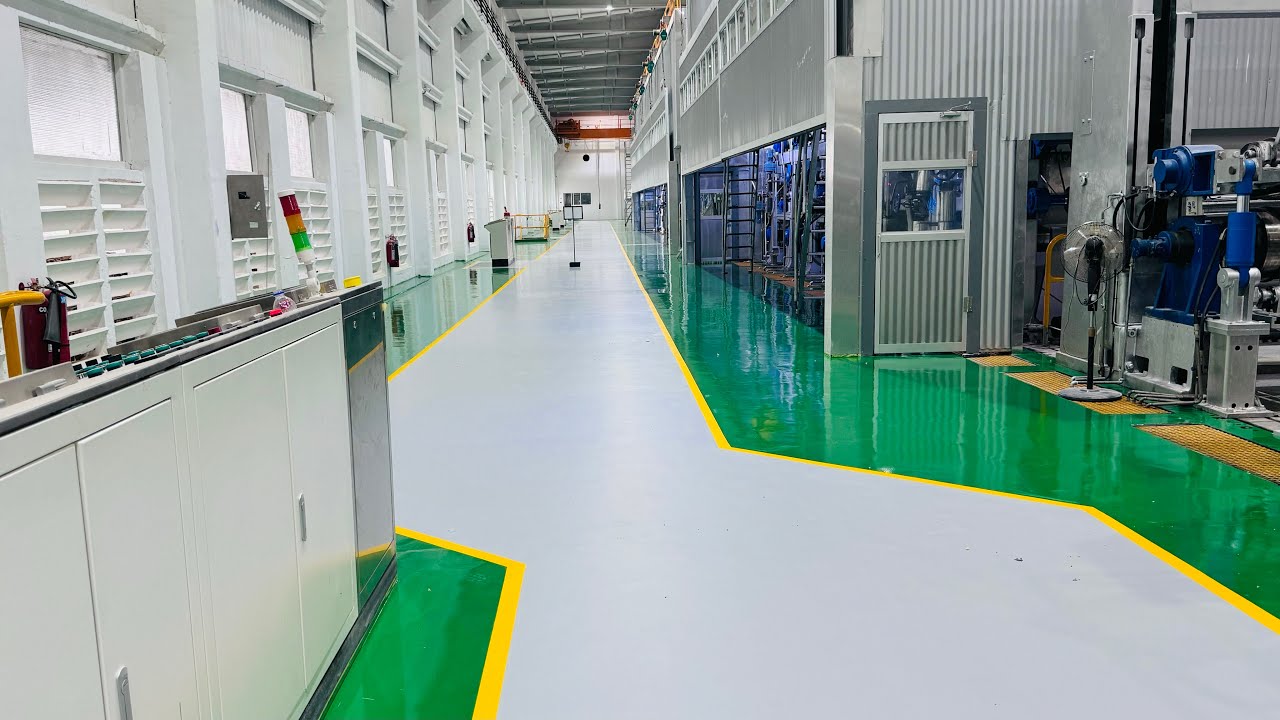
The Anti-Static Epoxy (ESD) system is a specialized flooring solution engineered to control electrostatic discharge (ESD).
Unlike conventional epoxy—which may act as an insulator or even generate static charges through friction—ESD epoxy features conductive or dissipative properties, allowing any accumulated static charges to safely discharge through a grounded path.
Key Features and Advantages of ESD Epoxy Flooring
-
ESD Control:
The core feature of this system. It provides a safe path for static charge dissipation, protecting sensitive electronic components, preventing ignition sparks in flammable environments, and safeguarding personnel from static shocks. -
Conductive Copper Grid:
Often incorporates a network of copper strips installed beneath the epoxy layer and connected to an effective grounding system. -
Conductive/Dissipative Materials:
The epoxy formulation includes specialized conductive materials (such as carbon fibers) that provide static control properties. -
Controlled Surface Resistance:
Designed to meet specific resistance ranges (typically between 10⁴ and 10⁹ ohms) to qualify as conductive or static dissipative flooring, based on industry standards like ANSI/ESD S20.20. -
Durability Comparable to Standard Epoxy:
Retains high mechanical strength, abrasion resistance, and chemical resistance. -
Ease of Cleaning and Aesthetic Options:
Offers the same smooth, easy-to-clean surface, available in various colors and finishes.
Common Applications of ESD Epoxy Flooring
-
Electronics manufacturing and PCB assembly facilities.
-
Server rooms and data centers.
-
Laboratories and R&D environments.
-
Pharmaceutical industries and biotech labs.
-
Operating rooms and hospital clean zones.
-
Aerospace and aviation industries.
-
Areas handling flammable or explosive materials (to prevent ignition sparks).
-
Ammunition and explosives manufacturing facilities.
Direct Comparison: ESD Epoxy vs. Traditional Epoxy Flooring
| Feature/Property | Traditional Epoxy Flooring | Anti-Static Epoxy (ESD) |
|---|---|---|
| ESD Control | Does not offer effective ESD control; may insulate or generate static charges. | Specifically designed to safely dissipate electrostatic charges. |
| Installation | Simpler and faster. | Requires additional steps (copper grid, grounding, special materials) and expert installation. |
| Cost | Generally lower cost. | Higher cost due to additional materials and specialized installation. |
| Surface Resistance | Very high (insulating). | Controlled within specific conductive or dissipative ranges. |
| Main Applications | General-purpose: garages, warehouses, workshops. | Specialized: electronics, medical, aerospace, flammable zones. |
| Protection | Provides mechanical and chemical protection only. | Adds electrostatic protection for sensitive environments. |
| Installation Expertise | General epoxy installation experience. | Requires ESD flooring expertise and knowledge of industry standards. |
Floor In: Your Expert Partner in Specialized Epoxy Flooring Solutions
When choosing between standard epoxy flooring and Anti-Static (ESD) systems, the key factor is understanding your facility’s operational requirements.
If your processes involve sensitive electronic components, flammable materials, or controlled static environments, then working with specialized experts is essential.
Floor In stands out as an industry leader with extensive experience in designing, supplying, and installing both epoxy flooring types—with a strong specialization in ESD Epoxy Floors.
The Floor In technical team combines deep engineering knowledge and practical expertise to accurately assess your facility’s needs and provide honest, tailored advice—whether that means a cost-effective traditional epoxy solution or a highly advanced ESD system ensuring maximum safety and reliability.
Their commitment to quality materials, certified products, and state-of-the-art installation methods ensures results that not only meet but exceed client expectations—enhancing both the safety and efficiency of their operations.

Which Is Best for Your Facility?
The answer depends entirely on the nature of your operations and the potential risks in your environment.
Choose Traditional Epoxy Flooring if:
-
Your facility does not handle static-sensitive electronic components.
-
There is no fire or explosion risk from static sparks.
-
You’re looking for a durable, attractive, and cost-efficient general flooring solution.
-
Your applications include garages, general warehouses, or light workshops.
Choose Anti-Static Epoxy if:
-
Your processes involve manufacturing, assembling, testing, or repairing delicate electronics (the most common use case).
-
You handle flammable or explosive materials where static discharges pose serious hazards.
-
You must comply with international ESD control standards such as ANSI/ESD S20.20.
-
Personnel and equipment safety are top priorities.
-
You require highly controlled environments like clean rooms, labs, or operating theaters.
Conclusion: A Strategic Decision for Your Facility’s Flooring
The choice between Anti-Static Epoxy and Traditional Epoxy Flooring is not merely aesthetic or structural—it’s a strategic decision that directly impacts product safety, operational efficiency, and personnel protection.
While standard epoxy provides an excellent solution for general-purpose applications, Epoxy Flooring offers specialized protection that is indispensable in static-sensitive or hazardous environments.
By understanding these fundamental differences, accurately evaluating your facility’s needs, and partnering with trusted experts like Floor In, you can make a sound decision that ensures optimal protection, superior performance, and long-term value for your investment.
Remember: the right floor is the foundation of a safe and productive workspace.